
Abstract
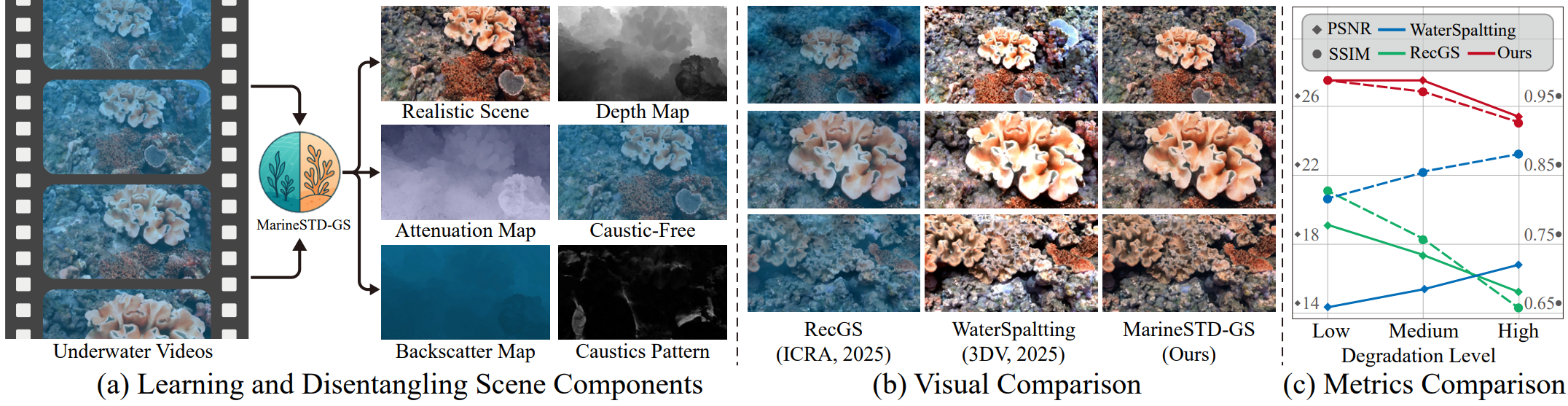
Reconstructing realistic underwater scenes from underwater video remains a meaningful yet challenging task in the multimedia domain. The inherent spatiotemporal degradations in underwater imaging, including caustics, flickering, attenuation, and backscattering, frequently result in inaccurate geometry and appearance in existing 3D reconstruction methods. While a few recent works have explored underwater degradation-aware reconstruction, they often address either spatial or temporal degradation alone, falling short in more real-world underwater scenarios where both types of degradation occur.
We propose MarineSTD-GS, a novel 3D Gaussian Splatting-based framework that explicitly models both temporal and spatial degradations for realistic underwater scene reconstruction. Specifically, we introduce two paired Gaussian primitives: Intrinsic Gaussians represent the true scene, while Degraded Gaussians render the degraded observations. The color of each Degraded Gaussian is physically derived from its paired Intrinsic Gaussian via a Spatiotemporal Degradation Modeling (SDM) module, enabling self-supervised disentanglement of realistic appearance from degraded images. To ensure stable training and accurate geometry, we further propose a Depth-Guided Geometry Loss and a Multi-Stage Optimization strategy. We also construct a simulated benchmark with diverse spatial and temporal degradations and ground-truth appearances for comprehensive evaluation.
Experiments on both simulated and real-world datasets show that MarineSTD-GS robustly handles spatiotemporal degradations and outperforms existing methods in novel view synthesis with realistic, water-free scene appearances.
Method
The overall pipeline of MarineSTD-GS
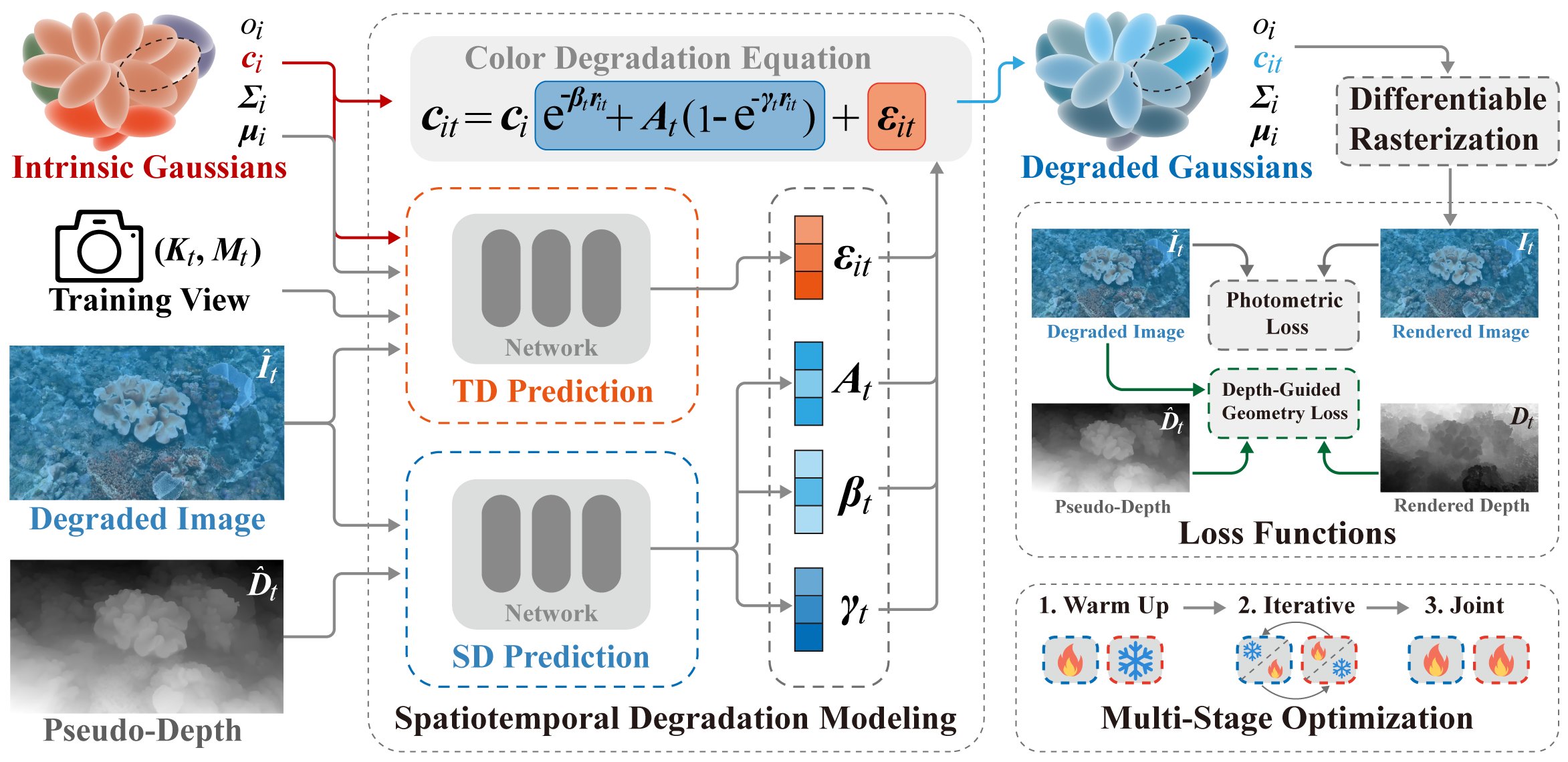
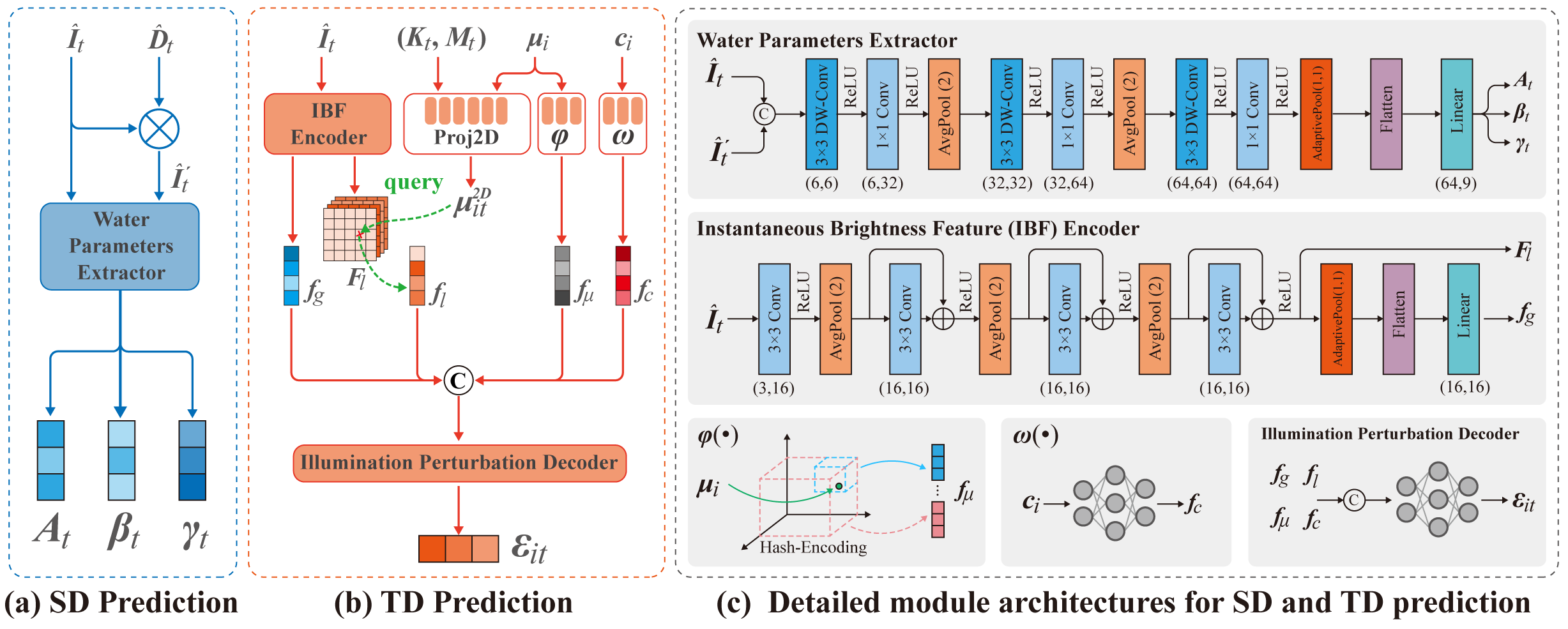
Structure of the Spatiotemporal Degradation Modeling module.
Results
1. Holistic Scene Understanding and Interpretation
MarineSTD-GS disentangles realistic scene representations from underwater videos, including true appearance (color and geometry) and degradation components like attenuation, backscatter, and caustics.
Disentanglement across Different simulated Scenes
S1, S2, and S3 scenes under Caustic Pattern A with medium degradation.
Disentanglement under Different Caustic Patterns
Scene S2 under medium degradation with Patterns A, B, and C.
Disentanglement under Different Degradation Levels
Scene S3 under Caustic Pattern A with low, medium, and high degradation.
Holistic Scene Understanding and Interpretation on Real-world Underwater Videos
Real-world videos from BVICoral and Flsea_VI datasets demonstrate the disentanglement of realistic scene appearance and degradation information in complex natural underwater environments.
